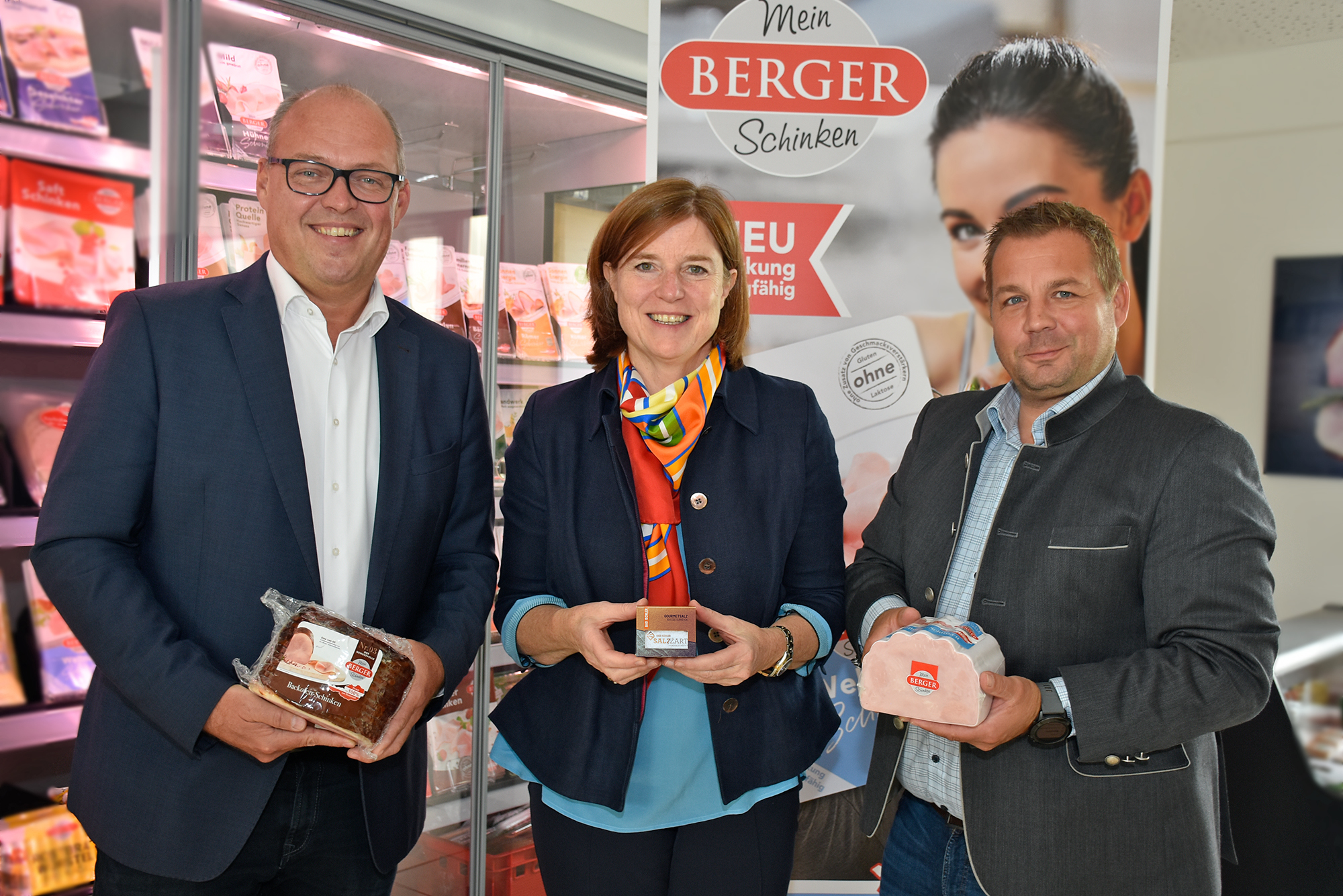
Austria's most popular ham with a long tradition
In conversation with Claudia Berger.
Tradition is an obligation – and has been for over 230 years!
It all began in 1890, when Michael Berger opened his first butcher's shop in Sieghartskirchen, Lower Austria. The quality of his goods was soon so convincing that it was awarded gold at culinary exhibitions in Vienna and Paris.
High standards for outstanding quality
The high standards set for its own products – and therefore for the suppliers of its raw ingredients – have remained, and have become the key driving force and recipe for success of this traditional Austrian company, now run by the 4th generation ("The 5th generation is just joining!").
Interview with Claudia Berger
Dear Ms Berger, thank you very much for taking the time to talk to us. Let's get straight to the point: is it still possible to eat meat in a politically correct way today?
It is! Meat has always been part of our diet and, as such, an important source of protein. In moderation, meat is therefore definitely part of a balanced diet for me.
You are driving product development in your field and, as a meat-processing company, you are not afraid to break new ground. What guides you in your further development, and which values and attitudes frame your corporate philosophy?
When developing our range, we are guided by what consumers want. This is how, for example, our reduced-fat products came about, which have been among our bestsellers for many years, as well as our reduced-meat line, in which we replace up to 40% of the meat content with mushrooms or potatoes, for example.
Sustainability and regionality are two key values for us: that is why we launched the climate protection programme "Regional-Optimal". Our contract farmers all come from the immediate surrounding area. Their animals are fed exclusively with feed from the Danube region – we do without overseas soy completely. This reduces CO2 emissions by almost half and at the same time guarantees GMO-free production.
In 2015, we launched our animal welfare initiative "Genuss mit gutem Gewissen" (Enjoyment with a clear conscience). It is the logical continuation of "Regional-Optimal". The animals are raised responsibly and in a species-appropriate manner on supplier farms in Lower Austria. They can live out their instincts – from movement to social contact – and are fattened exclusively with guaranteed GMO-free feed from the surrounding area. 100% more space than required by law, separate lying and activity areas, no fully slatted floors, soft straw bedding, access to outdoor runs, no tail docking and castration only under anaesthesia are the most important guidelines. The products are certified with the "Tierwohl verbessert" (improved animal welfare) seal by "Gesellschaft! Zukunft Tierwohl!". Our goal is clear: to expand and advance animal welfare.
What do you particularly value about the Austrian food market?
First and foremost, product safety. Our products are subject to the Austrian Food Codex, which is known to be one of the strictest in the world and strictly regulates additives. This level is second to none.
You rely heavily on regional cooperation partners. Does that work for your entire range?
At Berger Schinken, 98% of the pork we process comes from Austria. We are particularly proud that a quarter of it already comes from our climate protection programme "Regional-Optimal".
The situation is different for poultry and turkey meat: we work closely with two large Styrian poultry farms; nevertheless, demand across the market exceeds supply. For us as a producer, this means that we also have to buy in from beyond Austria's borders. Of course, the origin is transparently stated on every product.
How important is the designation of origin to you?
In our view, the designation of origin is very important. But this also requires flawless, easy-to-understand implementation: customers must be able to recognise the origin of the raw materials at first glance. For many years, we have been stating transparently – and voluntarily – where the ingredients come from. Through our cooperation with local farmers, we create added value for consumers.
For various reasons, giving up meat is a very emotionally charged topic.
More conscious consumption of animal products is unavoidable – and protects the environment. We take our responsibility towards future generations, animals and nature very seriously. Through our climate protection programme and our animal welfare initiative, we actively help to ensure that meat is produced and consumed as consciously and sustainably as possible. We are convinced that creating appreciation for higher animal welfare standards is a task for society as a whole.
All too often, discussions about eating meat and climate protection are based not on facts but on emotions. Apples are proverbially compared with oranges – animal products from Austria, for instance, carry a completely different climate footprint than imported ones.
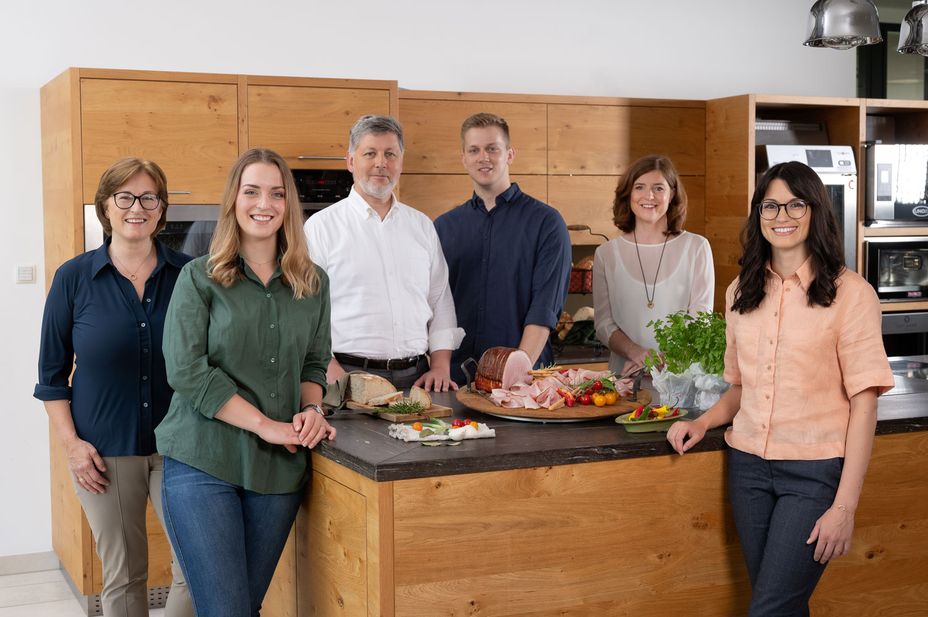
Together with your husband and your sister-in-law, you now run Berger Schinken in the 4th generation, and the 5th generation is "waiting in the wings". What would you like to pass on to the next generation?
We would love to promise them a secure future. Unfortunately, we can't. Our company, like society as a whole, is in a constant process of change. We want to hand over not just a thriving business to the next generation, but a future-oriented one. That is why we are now setting the course towards greening, sustainability and social responsibility.
The challenges of recent years have been unprecedented; the globalised world of goods, scarcity of resources and changes in consumer behaviour will also keep future generations busy. Part of the solution can therefore be to broaden our range – we have just launched our first vegan product.
Since 2022, we have had the pleasure of supplying you directly with GUSTOSAL. What do you value about your cooperation with Salinen Austria AG?
First and foremost, that the salt comes 100% from Austria. Security of supply and product safety are also key. And then, of course, the very personal and, above all, direct communication with a permanent contact person who also feels responsible for our concerns. This direct relationship also opens up new ways of cooperating. In addition, we share common core values, especially when it comes to handling resources and a clear commitment to regional value chains.
Thank you very much for these lovely closing words and the informative conversation!