
Salt in the meat and sausage industry
Why do we cure meat and sausage products?
What is curing?
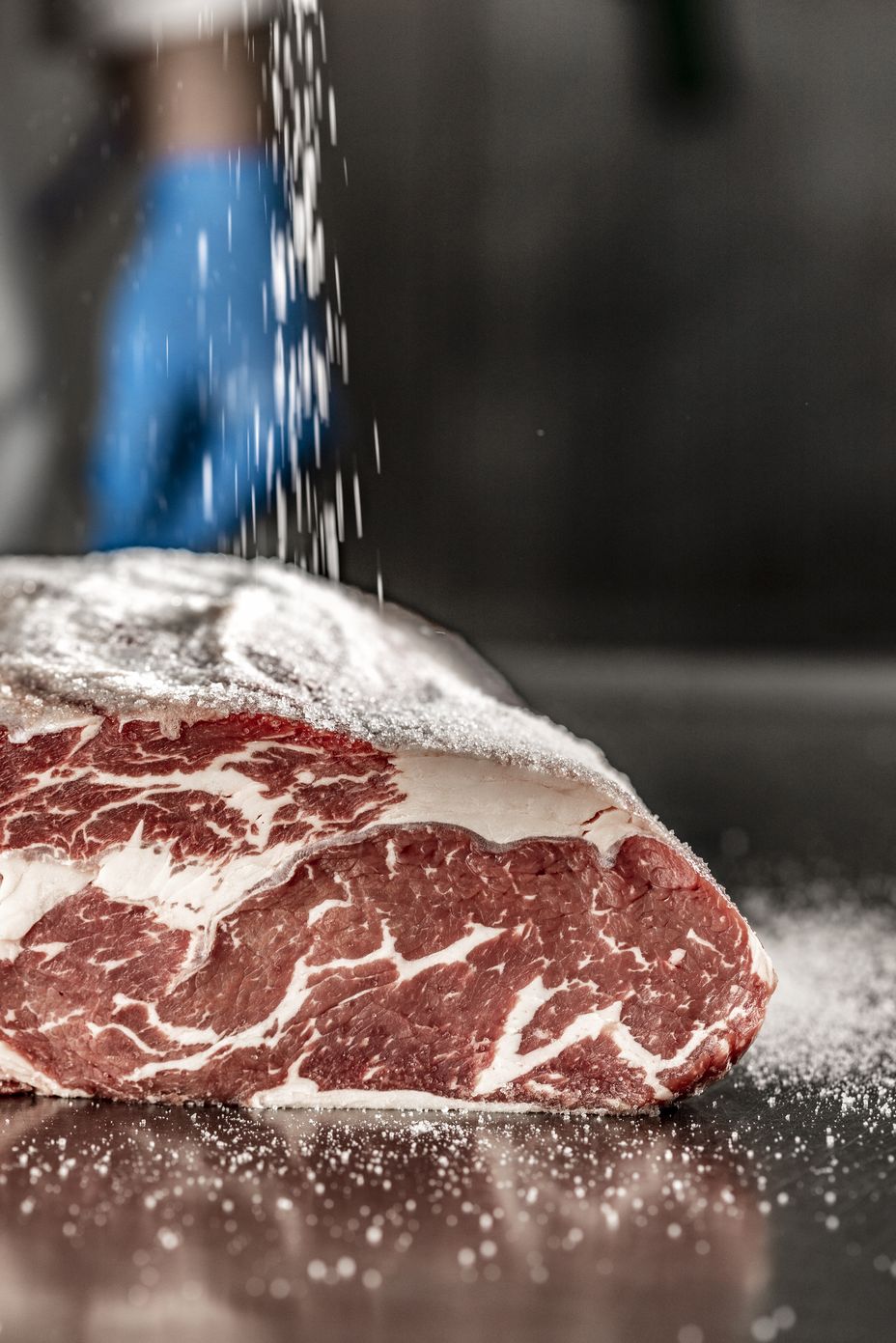
Curing refers to preserving meat by adding nitrite curing salt. Nitrite curing salt draws water out of the meat (through osmosis), so that it spoils less quickly. The chemical processes involved in curing give the meat its characteristic and attractive red to pink colour – typical of all sausages and many meat products.
Curing salt contains sodium nitrite (E 250) and potassium nitrite (E 249) and has a nitrite concentration of between 0.4 and 0.5 percent. Curing increases the salt content: while meat is normally low in salt, the salt content is 1.6 to 2.8% in cooked ham and 3 to 9% in raw ham.
An ancient preservation method
Curing meat is one of the oldest known methods of preservation: meat was already preserved by treating it with salt in ancient Mesopotamia and ancient Rome. The German term for curing, “Pökeln”, probably goes back to the Dutchman Gillis Beukel, who lived in the 14th century.
Bad for germs, good for shelf life
During curing, water is drawn not only from the meat itself but also from the microorganisms present in it: this prevents the growth of the bacterium Clostridium botulinum and therefore putrefaction. The meat also becomes firmer and lighter, and fats oxidise less. That is why cured products do not go rancid as quickly.
Colour formation
A certain colour and aroma are desired in curing. That is why table salt is mixed with salts of nitric acid: this allows the cured meat to keep its red or pink colour instead of turning grey. This process is also known as colour formation.
Dry, wet and injection curing
Dry curing is the gentlest but most labour-intensive way of curing and delivers the best results in terms of quality. The ham is rubbed with a salt mixture, traditionally by hand. The salted hams are then stacked on racks or in vats, allowing the natural brine that forms to drain off. This method is particularly recommended for large pieces.
 In wet curing, the pieces of meat are rubbed with a dry salt mixture and placed in curing brine. Because less water is drawn out, the result does not keep as long as with dry curing.
Injection curing is a typical method for cooked cured products: the curing agents are injected directly into the pieces of meat via the blood vessels or muscles. This speeds up the curing process.
 Why shouldn't cured meat be grilled?
Curing salt contains nitrite. When cured meat products are grilled or fried, at high temperatures – from 150 degrees Celsius – the nitrite from the curing salt reacts with the protein in the meat to form harmful nitrosamines. That is why cured meat does not belong on the grill or in the frying pan. When boiled, in soups or stews, the temperature does not exceed 100 degrees Celsius, so no harmful nitrosamines are formed.