
Salt with additives
Which additives are added to salt and what functions do they perform?
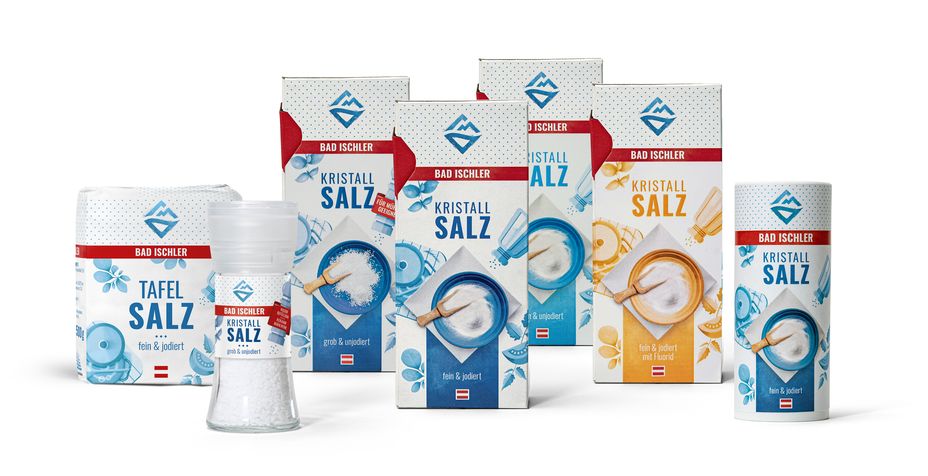
EU health claims regulate additives in salt.
Which additives in food make sense from a health perspective is regulated and justified by the health claims in Regulation (EU) No 432/2012. Because our soils are low in iodine, Austria is considered an iodine-deficient area. Iodine deficiency has a negative impact on health, which is why our table salt has been enriched with 15–20 mg iodine/kg since 1963 and labelled as iodised. At Salinen Austria AG, we use potassium iodide and potassium iodate for this.
Iodine: an important trace element.
Iodine is the best-known salt additive: it is important for thyroid hormones, which are involved in many metabolic processes and influence, among other things, our growth, brain development and energy balance. Both iodine deficiency and iodine excess can have negative effects on health. One of the best-known consequences of iodine deficiency is goitre (struma), which used to be widespread.
Regulation (EU) No 432/2012 states the following for iodine and potassium:
Iodine contributes to normal cognitive function.
Iodine contributes to normal energy-yielding metabolism.
Iodine contributes to normal functioning of the nervous system.
Iodine contributes to the maintenance of normal skin.
Iodine contributes to the normal production of thyroid hormones and normal thyroid function.
Potassium contributes to normal functioning of the nervous system.
Potassium contributes to normal muscle function.
Potassium contributes to the maintenance of normal blood pressure.
To keep salt free-flowing: anti-caking agent E536.
Grandma already knew: to keep salt flowing, you need a few grains of rice in the salt shaker. They absorb moisture, keeping the salt dry and preventing it from clumping. Ideal for household use, but unfortunately unsuitable for industrial salt production. That is why we use proven and strictly tested chemical additives to keep our evaporated salt free-flowing – such as sodium ferrocyanide, also known as E535.
How does the anti-caking agent get into the salt?
In the production of evaporated salt, a batch is prepared with water, dried and then evenly sprayed with an E535 solution on the conveyor belt (target quantity 110 ml/t). The anti-caking agent content of table salt is checked daily by the laboratory.
Prussian blue, not hydrocyanic acid
If salt containing E535 is used in a moist, acidic environment – such as in a dairy or cheese factory – the salt may turn bluish. This reaction is called “Prussian blue”. That is why E535 is often mistakenly confused with hydrocyanic acid: hydrocyanic acid is toxic to humans, but the sodium ferrocyanide used is harmless. In fact, a person weighing 80 kg would have to eat a whole 167 g of salt every day (more than 15 teaspoons!) to ingest a harmful amount of E535 via salt.